Catch Basins and Dry Wells in Waterloo, IA
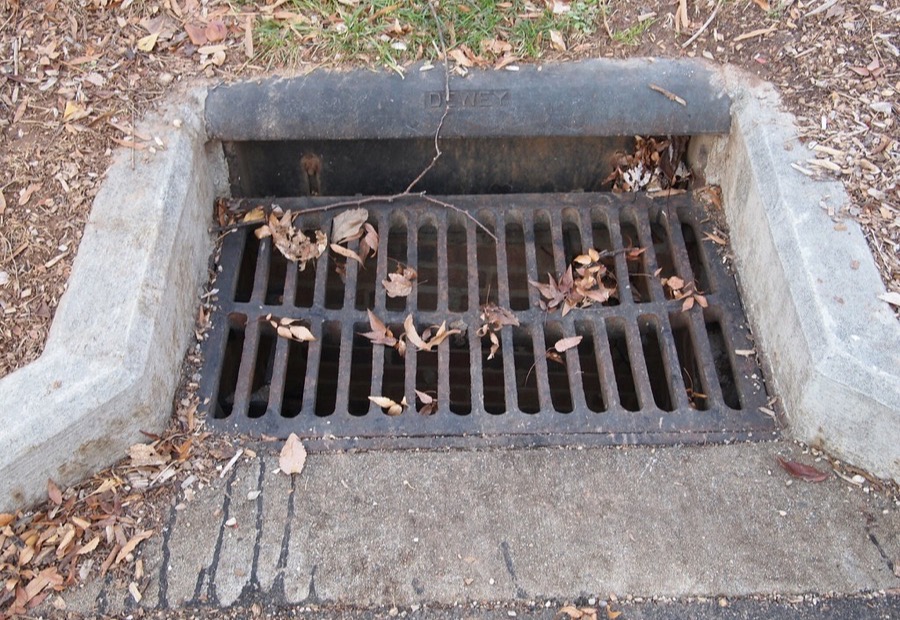
Waterloo Drainage Pros installs catch basins and dry wells for homes and commercial sites across Waterloo and Black Hawk County, Iowa. We are a licensed and insured drainage contractor. A catch basin gathers surface water at a low spot and pipes it away; a dry well stores water where there is no lower exit to send it to. Both handle water that ponds with nowhere to go.
A catch basin is a grated box set flush at the low point, piped to a lower exit. A dry well is a buried chamber packed in washed #57 stone and wrapped in geotextile filter fabric, and it holds water while the soil below soaks it in. The fabric keeps the clay out of the stone, so the well keeps its storage room instead of silting into solid ground.
When You Need a Catch Basin
A catch basin is for a spot that gathers water and has a lower place to send it. The foot of a sloped yard, a patio edge, a driveway apron, the base of a downspout run: water heads to these and settles. The basin hands it an exit. Water drops through the grate, the box holds leaves and grit, and the pipe carries the flow to daylight or another drain.
When You Need a Dry Well
Some lots have no lower ground to drain to. The whole yard is flat, the street is no lower, and there is nowhere to run a pipe. A dry well solves that by sending the water down instead of away. It stores a storm's worth of runoff in the gaps between the stone and releases it slowly into the soil, so the surface clears while the ground takes its time.
Sizing a Dry Well for Clay
Clay is the catch. It accepts water slowly, so a dry well on Waterloo soil has to be big enough to hold the runoff while it waits to soak in. We size the well to the area draining into it and to how fast the ground actually takes water, which we check on site. An undersized well fills and spills over in the first hard rain.
Tied Into the Whole System
Basins and wells rarely work alone. A yard drainage layout might feed several catch basins into one pipe, then to a dry well where the lot has no exit. A french drain that cannot reach daylight often ends in a dry well. We build the pieces to work as one path for the water.
What It Costs
A single catch basin with a short pipe is a small job, a few hundred to about a thousand dollars. A dry well in Waterloo runs about $1,500 to $4,000, since the size of the pit and the volume of stone drive the cost, and clay takes a bigger well. Every job gets a free written estimate first.
Have a low spot that never dries out, with nowhere to drain it? (319) 555-0196 gets you a free look and a straight read on whether a basin, a dry well, or a sump is the right exit.
What is the difference between a catch basin and a dry well?
A catch basin gathers surface water and moves it on through a pipe. A dry well keeps water and lets it soak into the ground. You use a basin where there is a lower exit to pipe the water to, and a dry well where there is not, so the water has to go down rather than away.
Do dry wells work in clay?
They work, but clay takes water slowly, so the well has to be sized for that. On tight Waterloo clay a dry well is built larger to hold a storm's worth of water while the soil drinks it in over time. Where the ground barely takes water at all, we look at piping to an exit instead.
Where should a catch basin go?
At the low point where water already gathers, the spot that ponds after every rain. That might be the foot of a sloped lawn, the edge of a patio, or a driveway apron. The basin sits flush with a grate on top, so the water that heads there drops in and leaves down the pipe.
How deep is a dry well?
Deep enough to reach soil that will take water and to hold the volume it has to store, which depends on how much runoff feeds it and how slowly the ground drains. On clay that usually means a good-sized pit or chamber packed in washed stone. We size it to the water it has to handle, not to a standard hole.